Care in Fabrication: An Enclosure for the Brookes
The work was technical and precise, but it demanded more than accuracy. Every choice required care.
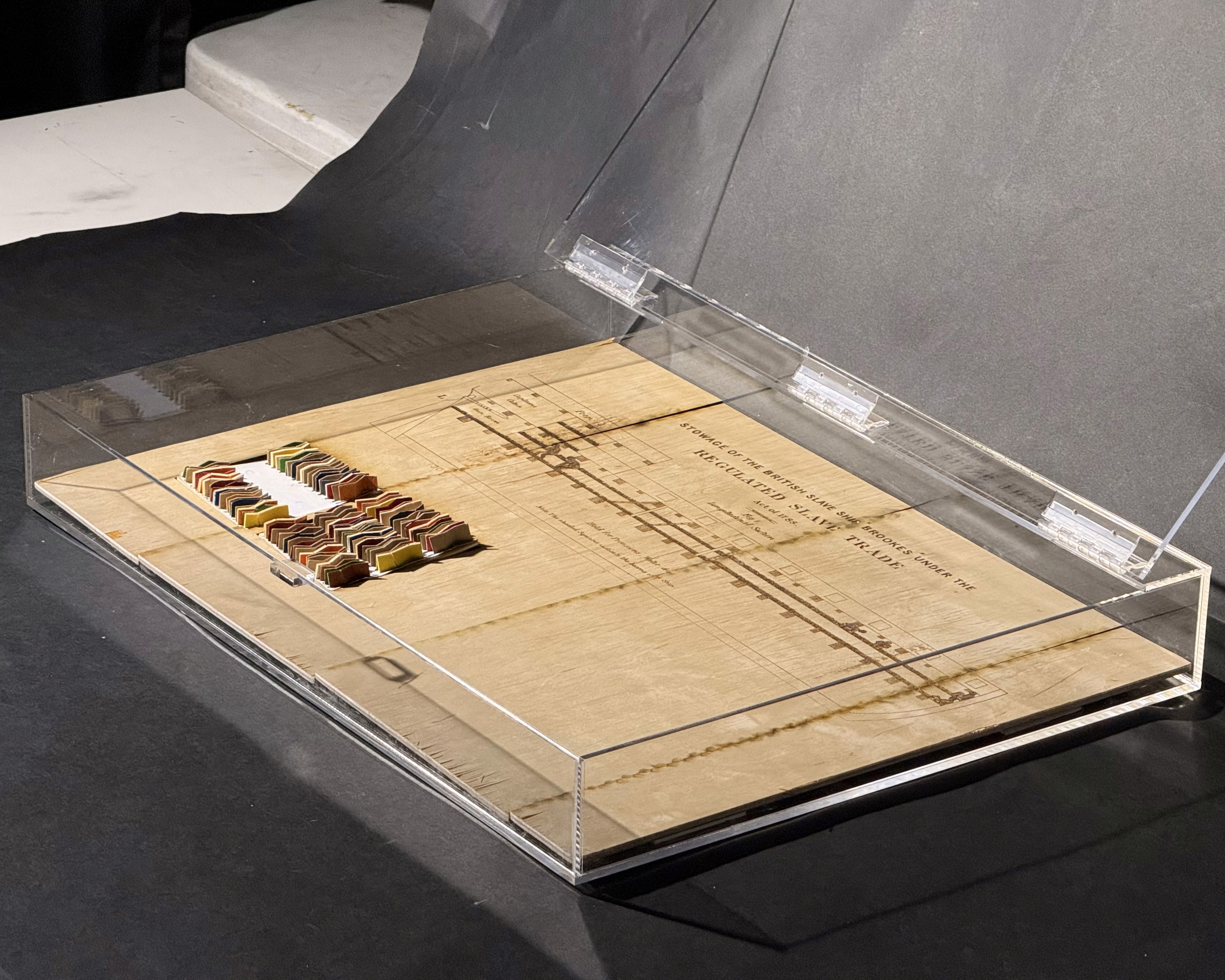
I recently had the opportunity to work with Professor Elgin Cleckley and Elizabeth Schmidt as part of _Mpathic Design on fabricating enclosures for a series of hand-made models depicting the floor plans of the slave trade ship "Brookes." My role focused on creating the wooden backdrops that would sit within acrylic cases and frame the models themselves.
From the beginning, it was clear that this task could not be treated as purely technical. The models carry immense historical and emotional weight, and the enclosure needed to contribute to that narrative rather than simply contain it. The wood could not be neutral.
I began by hand-selecting and cutting a raw birch plywood panel to precisely fit the acrylic cases. From there, I segmented each panel into eight-inch-wide strips using a laser cutter, intentionally referencing the scale of the ship’s floorboards. This decision was central to the project. These boards represent the surface on which enslaved people were confined, lived, and often died during the Middle Passage. Breaking the surface into discrete planks allowed the material itself to echo that reality.
During the laser-cutting process, I deliberately inverted the orientation of the wood so that the underside would absorb the burn and ash produced along each cut. When the panels were turned back to their correct orientation, the residue remained visible along the seams. The effect was subtle but intentional. The darkness settles into the joints rather than dominating the surface, suggesting how the violence and suffering tied to these spaces persist beneath what might otherwise appear orderly or composed.
Beyond this, much of the work involved careful assembly and problem-solving within the tight constraints of the acrylic enclosures. The tolerances were unforgiving, requiring precision and patience to ensure the panels sat cleanly without distracting from the models they support.
For one of the cases, I also laser-etched a section of the ship itself, allowing viewers to situate each floor plan within the larger vessel. Achieving the right balance here required extensive testing. I didn’t want the image to read as overly polished or decorative. Instead, I fine-tuned the laser settings to preserve a roughness that referenced the original paper documentation of the Brookes, reinforcing the archival and historical nature of the material.
Throughout this process, fabrication became a form of interpretation. Each technical decision carried narrative consequences, from material selection to tool settings. The final result is not meant to compete with the models, but to support them, allowing the wood, its seams, and its scars to speak alongside the stories they frame.